They said his music was a mess. They weren’t wrong. But the mess was the point. Modest Mussorgsky didn’t just ignore the rules of composition, he bulldozed them, buried the debris, and dared anyone to call it art. His music was an affront to elegance and a middle finger to refinement. His friends begged him to be more like them—tidy, respectable, European. They tried to fix him. But he didn’t need fixing. He needed time. Today, Mussorgsky is the only member of his circle of composers, the so-called Mighty Handful, whose work still echoes through concert halls, film scores, and sound design. The others faded. He didn’t.
That’s the spiteful magic of Mussorgsky’s legacy: he was dismissed, corrected, and ultimately pitied as a squandered genius, but in the end, he’s the one who endured. The harsh harmonies, the unbalanced phrasing, the refusal to tidy up are now the fingerprints of his brilliance. His music wasn’t interested in elegance. It was interested in truth. And if it sounded disjointed, unpredictable, even grotesque at times, it’s because that’s what life sounded like to him. His peers tried to clean him up, to edit him into acceptability. But what they couldn’t see, and what history eventually did: Mussorgsky wasn’t broken. He was ahead.
He was born into contradiction. Modest Petrovich Mussorgsky arrived in 1839 on a crumbling Russian estate, the child of aristocracy in decline. His family had titles, land, and a rapidly fading sense of their own importance. The serfs still served dinner, but the walls were already cracking. Russia was on the cusp of a social upheaval it didn’t yet know how to name, and Mussorgsky grew up straddling two worlds, one of privilege and one of decay. That tension, between grandeur and collapse, would follow him everywhere. Even as a child, he seemed haunted by it. His music, later in life, would carry the same contradiction: stately on the surface, but full of shadows underneath.
His musical education began early, but not with the urgency of prodigy myth. It was gentler than that, almost accidental. His mother taught him piano at home, not because she envisioned a concert career, but because it was part of a proper upbringing. He showed promise quickly, with a natural ear and a fluid touch, but no one mistook him for a future virtuoso just yet. What he had, even then, was an instinct for mood. By the time he was nine, he was performing small pieces for family guests, but even in those moments, there was a strange solemnity to his playing. It wasn’t cute. It was already unnerving.
At thirteen, Mussorgsky was sent to the Cadet School of the Guards in St. Petersburg, a military academy designed to turn aristocratic boys into disciplined officers of the Tsar. It was a strange place for a future composer, and an even stranger place for a boy already pulsing with creative tension. The curriculum was rigid, the hierarchy strict, the atmosphere soaked in nationalism and formality. Mussorgsky didn’t fit. He followed orders when required, but he absorbed none of the values the school intended to instill. If anything, it sharpened his allergy to structure. He didn’t rebel outright, he learned to mimic obedience, but underneath, the seeds of defiance were already blooming. Music became his private language, a refuge from uniforms, drills, and inherited duty. Even as he played salon pieces to entertain the officers’ wives, he was already chafing at the boundaries of what music was supposed to be.
By his late teens, it was becoming clear that Mussorgsky wasn’t going to stay on the path his family had chosen. He held a commission in the prestigious Preobrazhensky Regiment, one of the oldest in the empire, but his heart was already elsewhere. He haunted salons and soirées more than he drilled or marched. He drifted toward the artists, the intellectuals, the eccentrics who stayed up late and talked about philosophy, folk tales, and fate. The military still paid his bills, but music had taken hold of him entirely. He spent hours at the piano, experimenting with strange harmonies, echoing church chants and peasant songs, sketching melodies that wandered instead of resolving. By the time he met Mily Balakirev, the man who would become his mentor, the transition was already inevitable. The officer’s uniform still hung in his wardrobe, but Mussorgsky had already chosen a different kind of war.
Balakirev was the first to see something dangerous in Mussorgsky’s potential—and the first to try to shape it. Charismatic, controlling, and fervently devoted to the idea of a distinct Russian music, Balakirev became both mentor and gatekeeper. He believed Russia didn’t need to imitate Europe; it needed to sound like itself. No more polished imports from Paris and Vienna. No more borrowing the language of German symphonies. He wanted music that spoke the rhythms of Russian speech, that echoed the liturgies of Orthodox chant, that carried the weight of snow and soil and peasant sorrow. Mussorgsky, who had already begun following those impulses instinctively, was a perfect recruit. Under Balakirev’s influence, he began composing in earnest—small piano works, choral pieces, songs that felt rooted in something older and rougher than Western elegance. But even then, Mussorgsky resisted being molded. He admired Balakirev’s vision, but not his control. Where Balakirev demanded cohesion, Mussorgsky delivered chaos. Where Balakirev wanted discipline, Mussorgsky brought instinct. Their partnership would never be equal and never entirely comfortable.
The group that formed around Balakirev would later be called the Mighty Handful. It was a collective of five composers determined to wrench Russian music away from Western influence. It was meant to be a revolution. But like most revolutions, it was full of ego, friction, and competing agendas. Mussorgsky was the youngest, the most erratic, and the least polished of the five. The others, Cui, Borodin, Rimsky-Korsakov, Balakirev himself, had their own ideas about what Russian music should sound like. Mussorgsky didn’t argue. He just kept writing music that made them uncomfortable. His work was stranger, harsher, more uneven. Where they wanted unity, he delivered rupture. Where they wanted cohesion, he gave them jagged edges and unresolved phrases. They admired his raw talent but couldn’t quite trust it. Even among this group of so-called outsiders, Mussorgsky was treated like someone who needed correction, refinement, fixing. It was the beginning of a long, slow erasure disguised as friendship.
His song cycles, especially The Nursery and Sunless, left his peers uneasy—too stark, too introspective, too strange. He wasn’t writing to showcase vocal beauty or compositional finesse. He was writing to disturb. The melodies clung to speech patterns rather than traditional phrasing. The harmonies resisted resolution. Nothing sounded polished. Everything sounded human. Worse, it sounded like the wrong kind of human for them. It sounded lonely, flawed, aching, and unnoble. His fellow composers offered compliments laced with condescension. They admired his “originality” while quietly suggesting revisions. Rimsky-Korsakov, in particular, began to step in reorchestrating, smoothing, “clarifying” Mussorgsky’s intent. It was framed as help, as friendship. But beneath it was a growing sense that Mussorgsky’s work, left untouched, might embarrass them all. The revisions weren’t just editorial. They were ideological. The other members of the Mighty Handful had a vision of what Russian greatness should sound like. Mussorgsky’s music didn’t fit it—so they started rewriting him.
Boris Godunov was the work that should have secured Mussorgsky’s place in history, if history had been ready for him. Instead, it became the battlefield where his vision clashed most violently with the expectations of his peers, his audiences, and his country’s gatekeepers. He broke every operatic convention that mattered: no sweeping love story, no tidy arias, no aristocratic polish. Instead, he built the opera around the rhythms of common Russian speech and the psychological unraveling of a tsar haunted by guilt and prophecy. The music lurched and groaned. Characters stammered, faltered, broke down. It was a human tragedy, not a showcase of technique. That made it feel dangerous. When the Imperial Theaters rejected it for lacking a love interest, Mussorgsky didn’t compromise. He rewrote it, yes, but on his terms, doubling down on its emotional realism. He wasn’t writing opera for the elite. He was writing grief, collapse, paranoia, power, rot. And the people closest to him hated it for precisely that reason. They admired his courage. They just didn’t want to be associated with it.
The reaction to Boris Godunov was split right down the middle—admiration laced with discomfort, praise undercut by qualification. Some critics called it powerful, even visionary, but others dismissed it as crude, awkward, and incomplete. The public didn’t know what to make of it. It didn’t sound like opera. It didn’t behave like opera. It felt too close, too real, too bleak. There was no melodic balm, no dramatic glamour, just a slow descent into guilt and ruin. Mussorgsky’s peers winced. They’d wanted him to grow into something respectable, something that would elevate Russian music in the eyes of Europe. Instead, he’d written something grim and untamed, rooted in peasant cadence and emotional collapse. That was when Rimsky-Korsakov took it upon himself to intervene. He began “editing” Boris Godunov, reorchestrating whole sections, smoothing Mussorgsky’s jagged harmonic language, reshaping the opera into something more palatable. He called it stewardship. But it was erasure. Mussorgsky wasn’t dead yet, but his work was already being rewritten behind his back.
Mussorgsky never mounted a full-scale protest against the revisions because he was too isolated, too exhausted, and perhaps too accustomed to being misunderstood. But the betrayal cut deep. He knew what was happening. He saw his work being smoothed, civilized, drained of its volatility. He heard the orchestrations Rimsky-Korsakov claimed were “improvements” and recognized them for what they were: a quiet burial of everything that made his music dangerous. And he saw, just as clearly, that no one was going to stop it. His standing among his peers began to erode. The same composers who had once championed his raw genius now whispered about his instability, his drinking, his unreliability. His artistic vision, once treated as a wild promise, was now seen as a liability. He wasn’t evolving in the direction they wanted. He wasn’t polishing. He wasn’t learning to behave. So they began to write him off, not with confrontation, but with distance. One by one, they stepped back. Mussorgsky wasn’t just being rewritten—he was being quietly discarded.
The unraveling came slowly at first with missed deadlines, dropped correspondence, half-finished projects piling up in the corners of his apartment. Then it accelerated. Mussorgsky began drinking more heavily, not with the careless bravado of youth, but with the quiet fatalism of someone who knew he was being left behind. His commissions dried up. He lost his civil service post. The friends who once praised his brilliance stopped inviting him to salons. Even those who still admired him didn’t know what to do with him anymore. He wasn’t just unpredictable, he was inconvenient. He carried the smell of failure with him. He began drifting from one cheap apartment to another, sometimes relying on friends, sometimes sleeping in his clothes, sometimes disappearing altogether for weeks. The same man who had once shaken the foundations of Russian opera now spent his days shuffling through St. Petersburg, eyes dulled, coat threadbare, music unfinished. He was becoming a ghost in his own life—present but already being mourned.
By his late thirties, Mussorgsky’s body was beginning to show what his reputation had already confirmed, he was falling apart. His hands shook. His speech slurred. His once-bright eyes dulled under the weight of alcohol and disappointment. He took odd jobs where he could, mostly clerical work, barely enough to survive. Friends who still cared tried to help, but the help always came with demands to stop drinking, finish your work, compose something more refined. He couldn’t. Or wouldn’t. Either way, the result was the same: they withdrew. Even Rimsky-Korsakov, who had once called him a genius, now spoke of him in past tense, as a talent already lost. Mussorgsky became a cautionary tale—a man who had brilliance but no discipline, vision but no control. He was discussed more often than he was seen. And when he was seen, he looked like ruin: disheveled, broke, wandering. He had once written music that rattled the walls of the Russian establishment. Now he could barely afford a warm room.
In early 1881, Mussorgsky collapsed and was taken to a military hospital in St. Petersburg. His body was wrecked, liver failing, heart strained, nerves frayed past repair. He was only forty-two, but he looked almost twice that. Doctors could do little more than make him comfortable. Word of his condition spread quietly through artistic circles. A few old friends visited, out of duty more than devotion. Among them was the painter Ilya Repin, who arrived with a canvas and brushes to capture what little time was left. The portrait he made in those final days is one of the most haunting images in Russian art—a man not yet dead but already abandoned. Mussorgsky stares out, eyes glassy, skin sallow, hair disheveled. His hospital gown gapes open at the collar. There is no pose, no pretense. Just a broken man painted with brutal tenderness. That painting became iconic. The man himself was gone within days.
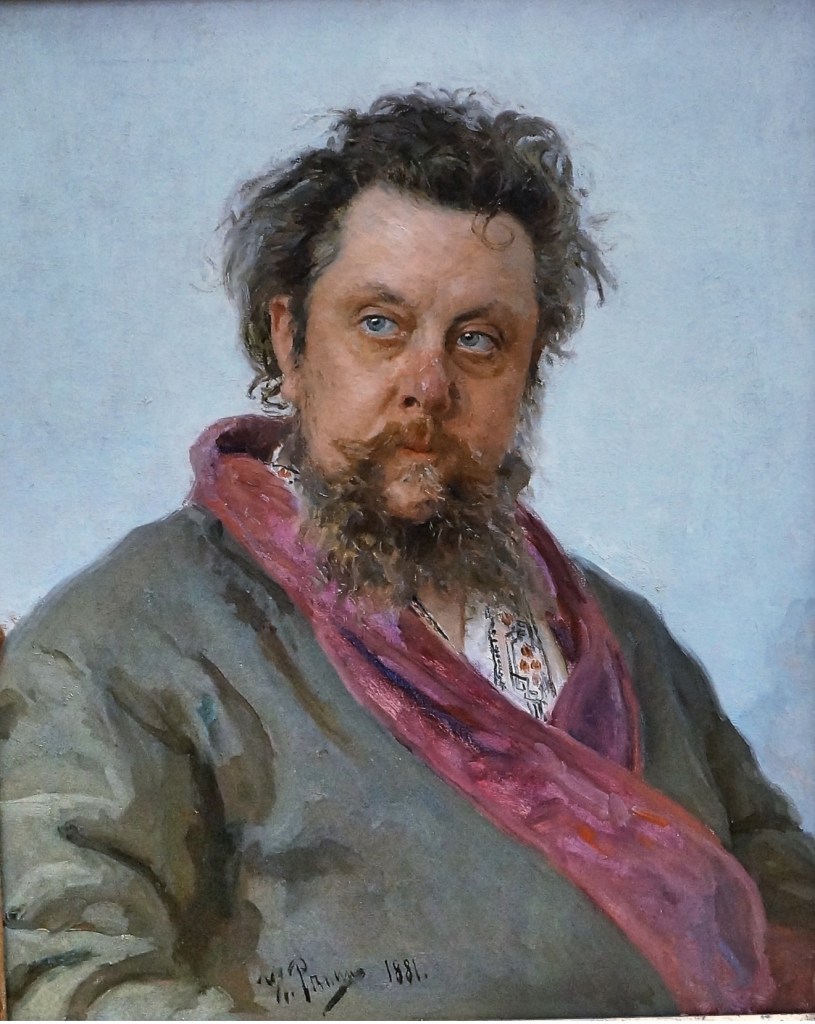
Ilya Repin, Portrait of the Composer Modest Petrovich Mussorgsky, 1881. Oil on canvas, Tretyakov Gallery, Moscow. Public domain.
His funeral was small, almost perfunctory. A few loyal friends attended, but there were no grand tributes, no national mourning, no sense that a giant had fallen. Mussorgsky slipped into the ground as quietly as he had slipped out of favor. The obituaries were respectful but restrained. He was remembered more for his potential than his accomplishments. The real work, it seemed, would be done by others. Almost immediately, Rimsky-Korsakov began reshaping what Mussorgsky had left behind. He revised Boris Godunov. He reorchestrated Khovanshchina. He smoothed the piano textures of Pictures at an Exhibition. He claimed to be honoring his friend’s vision, preserving the music for future generations. But what he was really doing, what the whole artistic establishment was doing, was making Mussorgsky acceptable. Palatable. Tamed. They couldn’t save him in life, so they refashioned him in death into something more presentable. It was a posthumous rescue mission no one had asked for and a quiet kind of violence that would take decades to undo.
For much of the twentieth century, the world knew Mussorgsky only through those altered scores, through the Rimsky-Korsakov versions that softened his rough edges and corrected his so-called errors. His name endured, but his sound did not. What orchestras performed was neater, brighter, sanitized—more ‘musical,’ maybe, but no longer Mussorgsky. Critics praised the ingenuity of his ideas while applauding the revisions that made them listenable. The rawness, the asymmetry, the destabilizing force at the heart of his music, those were treated like flaws that had been mercifully repaired. He became a kind of ghost composer: admired, but never fully heard. Rimsky-Korsakov’s fingerprints were everywhere, and few questioned it. Mussorgsky’s radicalism had been scrubbed clean. His revenge, it seemed, had been buried with him.
But history doesn’t always obey its early narrators. In time, musicians and scholars began to peel back the edits, to go looking for the voice beneath the varnish. What they found was astonishing. Mussorgsky’s original scores, raw, jagged, unruly, were not mistakes. They were masterpieces. The strange harmonies? Intentional. The lurching rhythms? Revolutionary. What his peers had tried to fix turned out to be the very thing that made him timeless. Performers began to abandon the cleaned-up versions. Conductors turned to his manuscripts. Recordings were reissued. Musicologists revised their assessments. Slowly, then suddenly, Mussorgsky’s real voice returned, not polite, not corrected, not smooth, but thunderous and strange and unmistakably his. And the others—the men who tried to tame him, guide him, outshine him? They faded. Balakirev is a footnote. Cui is a punchline. Even Rimsky-Korsakov, once the editor-in-chief of Russian music, is now remembered largely as the man who couldn’t see the future when it was sitting next to him. Mussorgsky didn’t need a monument. He got something better. He got the last word.
Mussorgsky didn’t just outlast his editors, he erased them. The men who once lectured him on taste and technique now survive only in footnotes, their music collecting dust while his roars through concert halls, soundtracks, symphonies. The same critics who once wrinkled their noses now teach seminars on his genius. The same orchestras that once refused his roughness now boast about performing the “original Mussorgsky.” His name commands reverence. Theirs are reminders of who couldn’t keep up. Rimsky-Korsakov may have orchestrated the notes, but Mussorgsky orchestrated the revenge. He was right. He was always right. And nothing tastes sweeter than the sound of a world finally catching up to the voice it once tried to silence.
It didn’t save him. That’s the part no revenge arc can rewrite. Mussorgsky died alone, discarded, and unseen. He never got to hear the applause. Never saw the world lean in closer. Never watched his former peers vanish behind him. But his music, untamed, uncorrected, unforgettable, carried him farther than any of them could imagine. And maybe that’s the true victory: not just to outlive your enemies, but to be heard, finally, on your own terms. No edits. No polish. Just the glorious dissonance of being right all along.


Ryan T. Pozzi writes about the brilliant, the broken, and the beautifully overhyped. His forthcoming book The Mess That Made Them explores the chaotic lives of legendary creatives like Mussorgsky. His next project, History’s Biggest Frauds, swings wider, dragging historical frauds, cultural icons, and self-mythologizing egomaniacs out into the daylight. He writes narrative nonfiction with sharp teeth: part biography, part cultural autopsy, part well-aimed side-eye. He’s the founder of the Nebraska Writers Collective and the Apollon Art Space, a member of several writerly organizations he occasionally remembers to mention, and a former nonprofit director who now writes full-time instead of punching a clock. He lives in Council Bluffs, Iowa with his wildly talented wife, Elizabeth, who’s far too good for this plotline, and posts irreverent thoughts on art, history, and literary chaos on Bluesky at @RyanWrites. His favorite historical feud is Edgar Allan Poe vs. Rufus Griswold. A petty, posthumous character assassination that backfired so spectacularly it built a legend. Guess who won? You know it was a proper metaphorical thrashing when you mention it at a party and people say, “Poe and who did you just say? Never heard of him.”