Dear S,
I recently saw your Instagram bio which, at the time of writing, reads, “pre-med alum.” Congratulations!
You might be wondering why I, who only knew you for one semester, would be writing. The truth is that I witnessed something the other day which reminded me of a conversation we had, in which I feel I misled you.
I was sitting outside the hookah-lounge just off campus when an older man approached two college girls, asking if they would want to share a hookah. They declined, but one offered a branch, saying, “I need to do homework right now. I’m around all the time, though, if you want to talk.”
“You’re just saying that,” he said. He reminded me of an insecure highschooler. In some way, I could relate to him, being insecure and once in highschool, but I was also embarrassed by this empathy. White stubble covered his jaw as if he’d fallen into sand and he wore a University hoodie. I wondered if this was who I’d become. It was something else he said that reminded me of you, though.
The scene continued like this, with the man asking for assurance and the two trying to ride the line between providing it and inviting him in. It was increasingly uncomfortable, but he eventually went inside. The two spoke to the staff and, in turn, the staff spoke to the man, forcing him to leave.
On his way out, he approached the two girls and said, “Someone ratted me out.” The two dropped their polite facade and, in no uncertain terms, told him to leave. He called them bitches and walked backwards down the street, staring at them. It was rather unsettling, but I do not mean to say this man reminded me of you. Rather, it was the way he said, “Someone ratted me out,” forming an indirect accusation, that reminded me of a question you’d asked me.
You might recall, before our penultimate lab, you failed the previous lab report. You asked me about it and my grade was higher. You said, “Did you say something to the T.A.?”
“That’s weird. Maybe ask the TA.” I didn’t meet your eyes as I said it.
I had, of course. I’d written a fourteen-hundred-word email, saying, “being in the lab, with [you] there, can be so actively frustrating that it makes failing the class sound preferable to being there a moment longer.” I imagined you knew I had written this email. That, my frustration was clear in my voice as we descended the stairs the week before. That, your question was an accusation.
You went to the T.A. but I do not know what he said to you. I imagine, though, he said enough. There was friction between us for the rest of the semester. I am sorry——I should have been honest with you.
The truth was and is that I hate you.
It was not any individual mistake. It was the culmination. How you never learned to zero a scale. How you stood unmoving at our bench. How you, when directed, would repeat the same mistakes. How the goggles pressed into my brow and how we couldn’t take them off until we finished. How the class crowded into their desks, working on the report for the lab which I—ostensibly, we—struggled to complete. How I grew light-headed, how my hands shook, as we sat together after the three-hour-long lab, working on an already-late report. How your cursor stood static in the shared document. Week after week.
You may think I’m unfair. You might say that I would have struggled even without you. This is true. If I were so able, none of this would be an issue.
It’s not just the lab, though. It’s the way that you seem aware of your own ineptitude and how you disguise it. You respond vaguely, in ways that reveal your confusion, and are often caught laughing at that which was not a joke. You perform the gestures of thought—looking up, scratching your chin—without the action of thinking itself.
Yet, you somehow graduated. You are not socially deft enough to act as a sycophant so, you must contain some well-disguised competence that has allowed you to succeed on your own. If I had been more patient with you, you could have been an asset. However, even if this is true, I cannot believe it.
To use an analogy: imagine you are dissecting a frog, and, as the scalpel glides down its stomach, you see its leg twitch from some latent electricity still held in its body. In this kick, the frog exhibited more neurological activity than I saw from you in our months together.
I was happy to read your bio because it suggests that you have not been accepted into a program and will not become a doctor. It is an assurance the world is, in some regard, still just. In my view, the only way you should enter medical school is as a cadaver.
In part, it was the build-up. I tried to be patient with you, hoping you would improve on your own. We agreed that this was not working. We agreed to come prepared. Yet, you never did. I bottled up my anger and let it fester into resentment. There was the social element, too. I blamed you.
I recently saw an acquaintance from highschool at Starbucks. As he heated the pre-packaged meals, I’d first noticed his balding head and his stomach. He approached the counter and called out names from printed labels. His voice was nasal, and his tone arched like that of a braying donkey.
I saw his name tag and I was back in class looking at him, as the air conditioner rattled above, and the teacher walked across the room. I was conscious of my body in that Starbucks, my too-tight shirt pressing against my stomach, the whistle in my nose as I inhaled, the grease on my skin. I feel a similar discomfort when I think of you now. I lay in bed last night, smiling as I compared you to a dead frog. I must believe that I can move past these thoughts, evolve. But, for this to be true, you must share this capacity.
Perhaps, one day, we will meet, and you will have found success. You will open the door to an examination room and see me sitting on the table. I will hear your breathless, airy voice as you confirm my name. How should I greet you then?
Perhaps, I will fail. You will be sitting outside a cafe one day and you will see me. I will go table by table, asking for a cigarette, or change, but, before I reach you, the staff will chase me off. Our eyes will meet and yours might widen with realization. I hope, in that moment, you will have a grace that I do not. That, you would let me turn and stumble down the street.

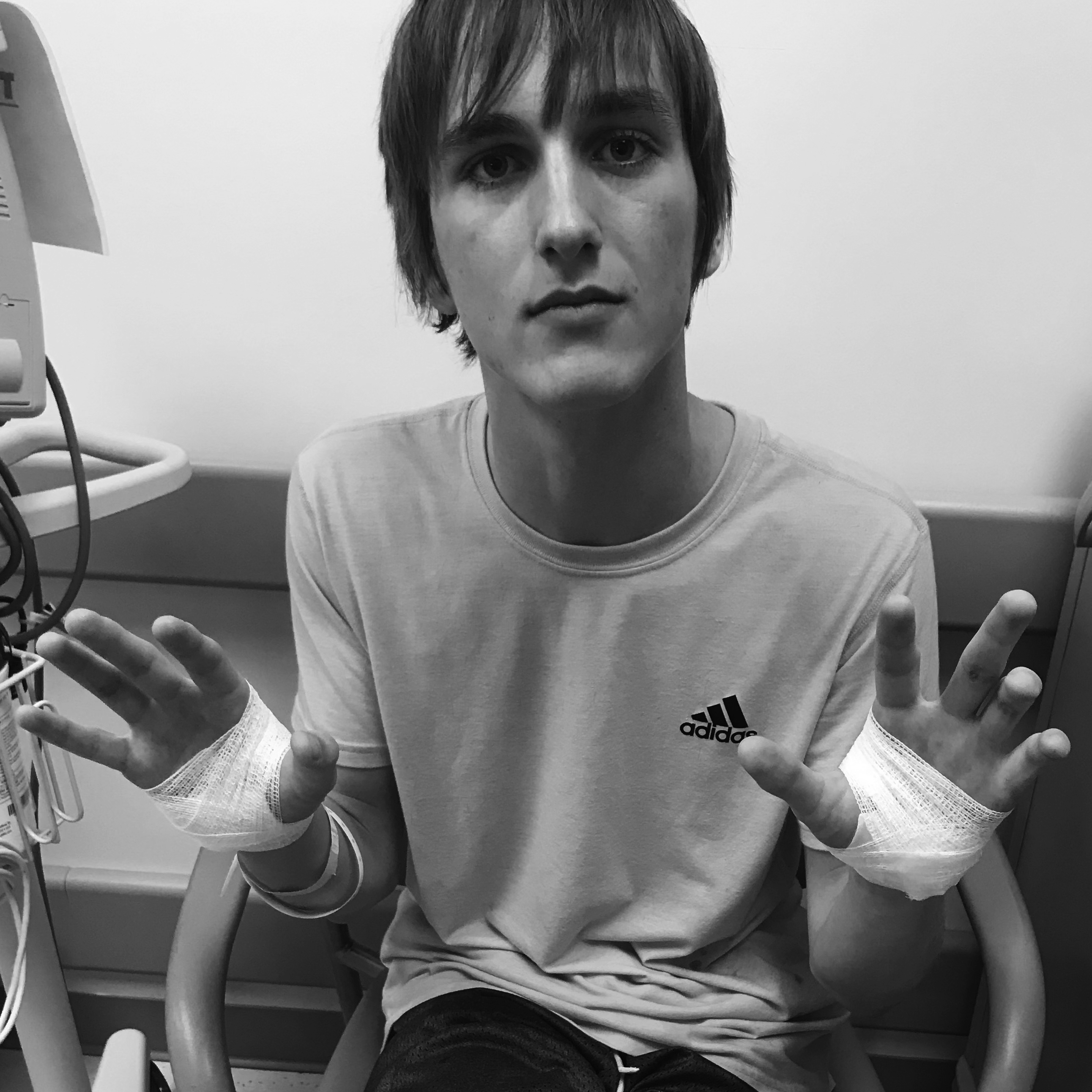
Elliot Hagyard‘s fiction has appeared in JAKE. If you want to find him elsewhere, you must check your corners as you enter a room. He loves Revenge by Yoko Ogawa though he doesn’t completely understand how much of the collection is actually about revenge.