Revenge Picking Up the Kids from School //
And It’s Raining and It’s Cold //
By 2:30 each day I feel like hell like a truck dragged me down the road and my skin is bleeding and sore. My muscles feel like they’ve been crushed and now the bruises are trying to save my life. My rheumatologist suggests a walker or at very least a cane and I don’t even consider it—I would rather my neighbors think my unbridled gait is because I am lazy and fat, and not because my leg is losing its ability to hold me up. I think this even though I am a disability activist. I think this even as a life-long fat liberation, anti-diet activist. I think
I might not be able to stay standing while I wait for the third grade to come out late as they are and there are no benches there are never any benches, or big rocks or stumps or anything but the flat ground, which if I sit on I will not be able to get up from again. I can’t juggle a cane and a stroller and holding a preschooler by the hand, I say to my rheumatologist. I lean on the baby’s stroller. When the kids come bursting out of the school door they want friends to come home with them, please it’s raining, we’ll be so bored, and I lie and say we have things
to do. I need to lie down
and take off my bra, and I can’t go to bed at 2:30 with other people’s children to watch. We’re going to build forts, I say, and watch movies, even though it’s a school day. I spin it like I am a fun mom, not a sick mom. Another mom speeds by me with her well-fitting raincoat and says something brightly that I don’t understand. I can’t remember her name, or which kid is hers, and I wonder if she can see the weird showing in my face. You think, this is a sad story, you think, where’s the revenge in this? this is just sad! But I’m telling you: let me twist what sounds sad into fun or weird or revenge. Let me twist it into good story and a real dream of an afternoon. Let me twist it so tight I could light it on fire like a birthday candle and blow it out, again and again and again.

Revenge Apartment Hunting
At twenty-one I was legally old enough to be released from the hospital into my own care, so I was. My parents felt it was best for me not to come home. I was told, by the doctors, not to stay at a friend’s apartment, the friend I had made in the months in the hospital, a beautiful woman with no revenge in her mouth. My parents left car keys at the front desk and did not choose to see me. The receptionist told me my mom was so nice. I felt very grateful for the car keys.
When I left the hospital parking lot, I gave a ride to a self-described junky, twelve weeks sober, who asked me to drop him off at the 66 Motel. He said he was going home to his family for Easter. His doctors told him not to go, but they also didn’t stop him. I dropped him off at the 66 and no one ever saw him again. I was twenty-one and not an addict, and I didn’t know I had just been conned, just been an accessory to someone else’s destruction.
So I then lived in my boyfriend’s college dorm room——thank god
for his kindness.
I shared his college-issued twin bed, used the shower on the men’s floor because if I went up and down the stairs to the women’s floor carrying my shower caddy and towel someone would know I was crashing there, illegally. The twenty-something Amherst boys would never rat me out, nodding politely as I padded down the hall, but I didn’t trust the women on the top floor not to tell the truth. In some versions of the definition this is being homeless: having no place to live, no bed of your own, no room that’s yours, because of mental illness. But I did not feel homeless, and this is not a sad story, just a regular story. I got a pet rabbit, a tiny baby, and named her after the locked ward I had just left. She was not allowed in the dorms, either. I guess you could say that was the revenge. The locked wards and buildings of psychiatric hospitals have distinguished-sounding names just like the dorms of college campuses: Oakwood and Cabot II and Morris. I don’t remember eating but I must have eaten. I took care of the bunny. I kept on living. The dead release the dead unto themselves.
If you want to go on living, you have to learn the difference between things that sound the same: the twist and click and rattle of locked, the twist and click and rattle of open.
They both sound like smooth rocks inside a shell.
There’s No Revenge Laundry Doing // Or Laundry Folding //
because when the universe seeps in like a flooded bathroom sink when hypoxia and fever make the universe soak my brain, it wants me to know I’m not over the ways my brain once descended on me like a ghost and I am not happy for this information.
Four kids in and middle-aged, I’d like to think I am over it, I’d like to think I am comfortably ensconced in some kind of permanent suicide protection plan, where the many little hands who reach for me also keep me tethered to a living life.
As soon as I type this I think about the last time I felt I had to stop for death, and how tiny the last-born set of hands were, days old, needing me literally to survive, and yet I couldn’t stop the yawn of my brain from opening like a thylacine so I could gape into the absolute nothingness horror. At that time I couldn’t sleep if I tried to lie down.
If I tried to lie down, it felt like death itself crouched on my chest and put its devilish face in my mouth while I breathed. If I sat upright in a rocking chair, gently rocked my own self with my own feet, sometimes I could fall asleep for an hour or two,
so that’s what I did, for months.
I would tuck my children in, I would say goodnight to my husband, I would nurse the baby one last time, and then I would rock and rock and rock myself to sleep. I had no trouble sleeping during the day, but of course, during the day I was caring for four very young children——there was no one else to do that work so I could sleep. And then the nights came and with them the thylacine teeth would start more or less at sunset, as though the universe was winching my chest open with a giant vise.
I told the postpartum nurse on the maternity ward that I was starting to hear voices and starting to see figures again, peering through the doorways. She looked at me very, very carefully, very very quietly. My newborn in my arms was purple with bruises from birth, we didn’t even have a name for him yet, he was that new.
It’s not a good time, the nurse says, slowly,
to be locked up here.
I am riddled with autoimmune diseases, including diabetes, and there are no vaccines for Covid yet. Diabetics are dying on vents in every city, their children saying goodbye over zoom. So I take my bruised baby and the yawning gape in my chest and the peering figures and the whispering voices and go home, and at night I close my eyes to the figures whose faces loom in the doorway at night. I put on sound machines, for the baby I say, and also for the whispers I don’t want to hear. I push the glider with my feet.
There, there, Meggie, I say. There, there. Keep alive, says my grandmother. Whatever you do, keep alive.
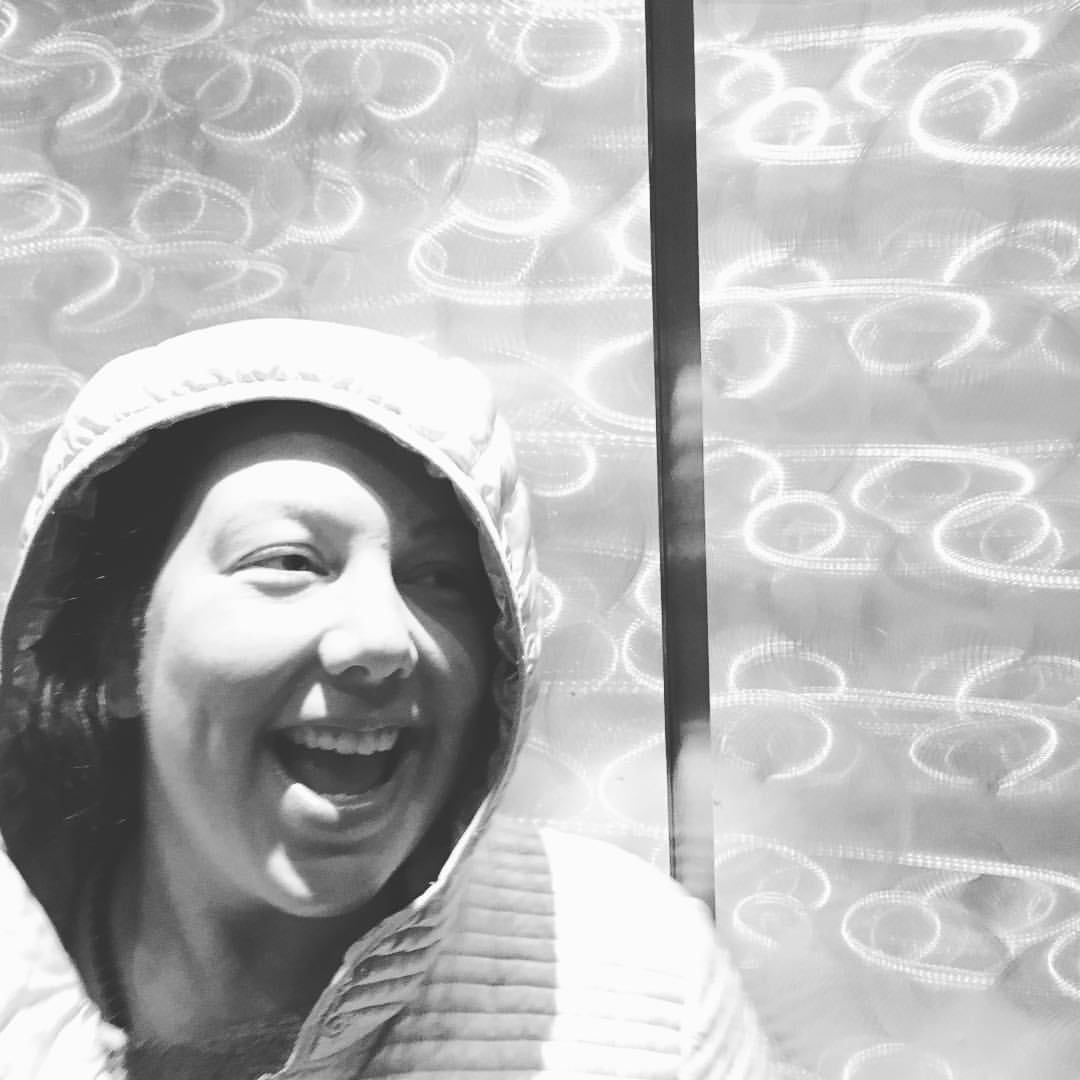
Megan Leonard (she/they) is the author of Larkspur Queen (Broadstone Books) and book of lullabies (Milk & Cake Press), as well as the chapbooks Dear ______ , (Milk & Cake Press, forthcoming) and where the body ends (Platypus Press). Meg’s work has recently appeared in Electric Literature, the Fourth River, and SWWIM. Meg lives in coastal New Hampshire, where she works as a writing mentor. Though primarily a poet, Meg also enjoys visual art and prose, and themes in Meg’s work often include disability and chronic illness, mental illness, madness, motherhood, and dark little fairy tales. Her favorite revenge story appears in the 12th century story “Lanval,” by Marie de France, where the Faerie Queen gets her revenge by riding a horse naked through King Arthur’s court. Well-played streaking is such irreverent and effective revenge.