When the stranger appeared, I was sitting on a bench at the edge of the beach in Marina del Rey, California, warming my bones like an old lizard. Before me, six athletic young women played volleyball on a court outlined in the sand with blue plastic tape.
I did not see the stranger approach. One moment I had the bench to myself. The next moment I glanced over and there he was. “Here,” the stranger said, and he unfastened his wristwatch and offered it to me.
I took the offered wristwatch because sometimes you take things that are extended in your direction for no better reason than because they are extended in your direction. But you never know. When a stranger offers to hand you something, it might be a winning lottery ticket or it might be a grenade with the pin pulled.
I looked at the wristwatch and realized it wasn’t one. It was a medical-alert bracelet, complete with a Rod of Asclepius etched onto the metal plate that faces the wearer. The metal plate was, except for the Rod of Asclepius, blank.
“I don’t get it,” I said. “This doesn’t say anything.”
“Not anymore it doesn’t,” the stranger said.
“But you’re saying it did,” I said, and I tried to load it with as much audible skepticism as I could.
“Yes,” the stranger said, “it told me to find the old dude sitting on the bench at the beach near the Fleet lifeguard station and hand the bracelet over to him.”
“The bracelet told you that,” I said.
“What I mean is, that’s the message that appeared on it,” the stranger said.
“You’ll understand if I don’t believe a word you’re saying.”
The stranger laughed. “I’d be surprised if you did.”
I studied the bracelet. “Isn’t this supposed to say ‘Coumadin’ or ‘allergic to artichokes’?” I asked, in spite of myself. I couldn’t believe I was having this conversation.
“This one is different,” the stranger said. “Instead of saying what drugs you’re taking or what medical conditions you have, this one tells you what you must do.”
“In order to what?”
“In order to get whatever it is you tell the bracelet that you need,” the stranger said.
Enough.
I’d had my quota of crazy for the morning. “Go away,” I said. “Find a nice shrink to talk to.” I put the bracelet down on the bench, beside him.
He stood, turned his back to me, and began to walk away down the beach.
“I don’t want the damn thing!” I yelled at him. “Take it back!”
The stranger didn’t look around.
It occurred to me that maybe I was getting punked or skunked or whatever they called it. Some variation on the old Candid Camera tv show. I glanced around. I couldn’t spot a camera or a hovering drone or Allen Funt.
When I looked back, the stranger had disappeared.
The bracelet lay on the bench, where I had placed it. I didn’t touch it. But I also didn’t move. I gazed at the young women playing volleyball. My god, they were beautiful to watch. Running and bending and reaching, leaping and arcing their bodies as they hovered impossibly in the air before striking the ball, then landing softly back on the sand without crumpling to a heap or crying out in pain or being forced to call an ambulance.
I snatched up the bracelet and limped home, holding one hand to my ribs.

The reason I was limping and holding my ribs was because of what happened earlier the same day, before the stranger appeared.
My career had recently ended somewhat past the traditional retirement age, and I discovered that I was having a hard time getting up in the morning. I had no part-time job. I never developed any hobbies. I did no volunteer work. Among the eight billion people on the earth, there was not one of them who was waiting for me to perform a task of any kind.
So, it probably shouldn’t have come as a surprise that despite repeated resolutions made in the night that I would rise with the sun, when the morning alarm sounded I couldn’t think of a good reason not to reach over and slap it into silence. It wasn’t as though getting up late prevented me from doing something useful. But getting up late was still a problem. After a lifetime spent working, my laziness filled me with self-disgust.
The Vagabond Alarm Clock seemed like the perfect solution when I ran across it online.
The day that the stranger appeared was the day of the Vagabond Alarm Clock’s debut. The device’s alarm went off as scheduled at six o’clock in the morning. I immediately realized that I had allowed a foolish ambition to get the better of me. It was still dark out.
I rolled over to turn the damn thing off.
Too late.
The Vagabond Alarm Clock took off under its own power, narrowly avoided my reaching hand, skittered across the bedside table, tumbled over the edge and onto the wood floor, righted itself on its rubber tires, and took off for parts unknown, irritating alarm still ringing.
The product description said that it was designed to force the sleeper to wake up in order to get out of bed and silence the device. It worked to specs.
When I swung my legs over the side of the bed to begin the pursuit, pain from the arthritis in both my hips lanced through me. I ground my teeth and planted my feet on the floor in order to stand. My knees registered a protest beneath their surgery scars.
Halfway to righting myself, the muscles in my lower back seized up. I was left standing, bent over at the waist, in approximately the position required for the annual prostate exam.
As I crabbed sideways in pursuit of the sound of the alarm, my left foot slammed into one foot of the bed frame. The bed frame won. My left foot yielded with a crunch.
“Ow, ow, ow,” I observed as I hopped across the room on my right leg, each hop sending bolts of agony through my right hip, my right knee, and my back.
I lost my balance and toppled over. As I fell, the edge of a mahogany bureau struck me in the ribcage.
I lay on the cool wood floor. My hips and knees hurt, my left foot hurt, my back hurt, and I was pretty sure I had cracked a rib or two. I wanted to weep but thought that would probably hurt as well.
The Vagabond Alarm Clock rolled across the floor and into my field of vision. It stopped two inches from my nose. I stared at it. It didn’t move. The alarm continued.
It began to roll away again but before it could, I seized the device, silenced it, and wrenched off one of its rubber tires.
I released the Vagabond Alarm Clock, and again it took off. But now it moved around the floor in tight circles, a vagabond no more.
Which explains why I was limping and holding my ribs as I left the beachside bench later that morning in possession of the medical-alert bracelet.
When I opened the door to the condo and stepped inside, I caught only a glimpse of my granddaughter, Cass. She said nothing, hurried past me with her head down, went to her room, and closed the door without a sound.
After living together for a considerable time, Cass and I got along well. She usually greeted me with a cordial insult, and I typically responded in kind. She was also someone who tended to close doors and cupboards and drawers with a bang, like she wanted to show them who was boss. Both her effort to avoid me and her silence were concerning.
I stashed the medical-alert bracelet, went to Cass’s room, rapped a knock, and opened the door without waiting for a response.
Cass stood facing the window. Her back was to me. “You have some real boundary-recognition problems, you know that?” she said.
I waited. The Vagabond Alarm Clock was safely stowed in the trash, so the condominium was silent.
Cass sighed. “I think I’ve managed to date every sleazy dickbag in Los Angeles,” she said eventually.
“Don’t worry,” I said as cheerfully as I could. “I’m sure there are still plenty of sleazy dickbags outside of L.A. for you to choose from.”
I hoped for a laugh but didn’t get one. Instead, Cass lowered her head, which exposed the back of her neck. It looked downy and vulnerable.
“I’m just so tired, grandpa,” Cass said.
That was more than concerning. That was alarming. Cass usually called me ‘grandpa’ only when there was sobbing involved.
“Come on, kiddo,” I said. “You’ll see, everything is going to work out.”
“How do you figure?” Cass said.
“Someday you’ll meet a nice guy,” I said. “And you’ll have a kid, and your kid will have a kid, and then your kid and her husband will die in a car wreck, and your kid’s kid will have to move in with you. And you’ll dread it and think it’s going to ruin your life, but later on you’ll decide that having your kid’s kid live with you is one of the best things that ever happened to you.”
Cass turned toward me and smiled. She had a bruise on her forehead and some swelling in the area of her left eye. The smile caused a fresh, comma-shaped scab on her lower lip to open up. A drop of blood crawled down her chin.
I felt myself fill up and enlarge, like a party balloon getting a shot from a tank of helium. It took me a moment to recognize the feeling as rage.
Cass stepped over and hugged me. She lay her head against my chest. “That’s some great circle of life shit you’ve got going on there, grandpa.”
“Where does he live?” I said.
The house at the street address Cass gave me fronted on Ballona Creek, the tidal channel that feeds the Venice Canals.
There was a convertible Maserati parked in front. Just the thing for any gentleman who lives on a street where the speed limit is 15 miles per hour.
The asshole answered the door shirtless. He was big. He bulged. Veins protruded beneath the skin of his biceps. He must have lifted a lot of weights when he wasn’t busy hitting girls.
I said a few things critical of his conduct, character, and heritage; the asshole responded with laughter and insults. The episode ended with him picking me up and stuffing me into one of the rolling plastic bins that the City of Los Angeles uses to collect garbage. He slammed the lid closed.
I waited for a while in the darkness of the bin with only the asshole’s trash for company, hoping that he would be gone by the time I pushed open the lid. As I waited, two things became apparent. One: The asshole ate a lot of fish. Two: Whether I lived for another twenty hours or for another twenty years, it wouldn’t matter.
Age had taken from me most of the qualities that once served as the props to my self-respect. Arthritis had robbed me of a modest pride in my athletic ability. I shied from admitting it, but my mind was dulling and I knew that I was forgetting more things. And I no longer had the pride you get from the simple fact that you have a job and are supporting yourself.
Despite all these losses, until that morning I had retained the sense that I still possessed some essential kernel of human dignity.
Folded up in the darkness of a trash bin that smelled like week-old sea bass, I knew that any trace of dignity I once had was gone. This was a humiliation from which I would never recover.
When I got home, I was relieved to find that Cass was gone. I spent a long time in the shower. My clothes were a lost cause. I bagged them and pitched the bag into a neighbor’s trash container.
In my bedroom, I took a pair of purple socks with clocks on them out of a bureau drawer. I unrolled the socks and a plastic pill bottle dropped into my hand. The label read “Nembutal (Pentobarbital) 500mg caps.” There were 28 capsules in the bottle. More than twice the lethal dose of the barbiturate. I bought them off a doctor who was in danger of losing his medical license because of a series of unfortunate mistakes made while under the influence of various opioids. He needed money for his defense.
Underneath the pill bottle was an envelope with Cass’s name on the outside. My written good-bye, prepared over the course of the last couple of years.
I carried the pills and the envelope out to the small dining-room table and went in search of the Grey Goose to wash down the Nembutals. I opened the liquor cabinet and found the medical-alert bracelet lying next to the vodka.
I didn’t remember putting the bracelet there, but I must have. I took vodka and bracelet and placed them on the table beside the pill bottle. I considered my options. A sure thing versus a fraud. Barbiturates and alcohol versus the stranger’s bracelet.
What the hell. When the bracelet turned out to be a phony, I would still have the Goose and the Nembutals.
The metal plate next to the Rod of Asclepius was still blank. “I want…” I began, and stopped. “No,” I corrected, remembering what the stranger said on the beach, “I need revenge on the guy who beat up my granddaughter.”
I stared at the bracelet’s blank plate. Nothing. Still blank. Big surprise.
I retrieved a tumbler for the vodka, got ready to pour, and froze. The bracelet plate now said:
EAT YOUR APPLESAUCE.
I lowered the Grey Goose to the table. My mind skipped over the impossibility of what was happening and went straight to trying to figure out what I was being told by the bracelet. Concentrating on understanding the message was probably a defensive tactic employed by my brain in order to avoid dwelling on the conclusion that I had trespassed into the no-fly zone of the truly loony.
I wasn’t sure what the “your” meant. Was it non-specific? Like the way a dietitian might say, “Eat your leafy greens.” She wouldn’t be insisting that you eat the particular head of kale that was sitting in your vegetable drawer. It would be a general admonition.
Or was the bracelet being specific? Maybe I was being told to consume some particular applesauce.
I went to the kitchen and opened a cupboard. Minutes later the counter was full of out-of-date cans of green chiles and jars of marmalade from Christmases past. And there it was: one forgotten jar of applesauce nestled in the farthest corner of the top shelf.
I grabbed it and wiped the dust off with a kitchen towel. The best-by date stamped on the lid was more than six years old. It was no longer a shock when I glanced at the medical-alert bracelet and found that there was a new message on it:
IT’S PROBABLY FINE. EAT IT.
Just what I needed. A trip to the ER for food poisoning. This whole thing was nuts.
But unless I was hallucinating or this was a dream, the message was there on the bracelet, and it had not been there before. There was no rational explanation for that.
After three tries, I managed to wrench open the lid of the applesauce jar. It gave way with a loud pop.
I didn’t want to think about what kind of bacterial activity would be required to produce that loud popping sound. I smelled the contents of the jar. Nothing about the aroma made my head snap back.
I worked up my courage by imagining in detail what I would do to the asshole if only I could. I reminded myself that Cass knew the lawyer who drew up my will. I grabbed a spoon, took a deep breath, and shoveled all the applesauce into my mouth as fast as I could.
Nothing happened.
I checked the bracelet. The message had disappeared.
It was a disappointment. On the other hand, I had eaten a whole jar of applesauce so out of date that people starving in a bomb shelter wouldn’t have touched it, and I didn’t feel like explosive diarrhea was in my immediate future.
I returned to the kitchen, rinsed out the applesauce jar, and dropped the jar into the recycling. The bag was full, so I pulled it out to take to the recycling bin.
Something’s wrong.
I stood, unmoving, and tried to figure out what it was. Then it hit me like I was inside the blast radius of a Tesla.
Nothing hurt.
I couldn’t believe it. I twisted to my left. Then to the right. Not a murmur from my back. I bent at the knees, then the waist. All the way down to the floor in a squat and back up again. Nothing. Not a twinge from my knees or my hips. Even my ribs and the toes I’d mashed against the foot of the bed felt fine.
I noticed that I still had the full bag of recycling in my hand. I had forgotten it was there. It felt weightless. I was strong.
The grey veil of physical discomfort that had draped itself over me every waking moment for years had been whisked away. I felt unbound. It was a miracle.
You know the cackling jig Walter Huston did in The Treasure of the Sierra Madre when his character realized they’d struck gold in the middle of nowhere? That was me in the condo, dancing around like an insane person and waving an 11-gallon plastic bag full of bottles and cans over my head.
I realized that I even remembered the name of the actor who was standing next to Humphrey Bogart when Huston did his desert jig. Tim Holt. Who the hell remembered Tim Holt’s name? Maybe his grandchildren. And me. My mind was organized and replete.
I shelved the Grey Goose, re-hid the Nembutals in my socks with clocks, stashed the farewell message, scribbled a note to Cass, and went out. Headed back to the asshole’s house. I even ran part of the way and felt the same boundless freedom I had when I was seven years old and first rode a bicycle without falling over.
When I got to the asshole’s house, the convertible Maserati was still out front.
I grabbed the garbage bin into which the asshole had recently stuffed me, hoisted it over my head without effort, and deposited the contents onto the driver’s seat of the Maserati. The aroma of rotting fish perfumed the air.
I tossed that garbage bin aside and snagged the one waiting at the curb in front of the house next door. As the material from that bin began to pour onto the passenger seat of the Maserati, I was pleased to observe from the quantity of litter and ordure that the neighbor cared for a large family of indoor cats.
I was tossing the second garbage bin aside and considering the word “clowder” when the asshole burst from his house.
“What the hell do you think you’re doing?!” shouted the asshole. He wore a white t-shirt. Blood vessels ribboned the muscles of his neck and arms.
“Getting a weasel to come out of its burrow,” I said.
Apparently not satisfied with my answer, the asshole took half a dozen strides in my direction and smashed me in the face with a straight right hand.
It felt like a floating soap bubble disintegrating against my jaw.
I’m invincible! I’m Geezerman!
I seized the asshole by the shoulders, spun him around, grabbed hold of the back of his belt, picked him up, and carried him like an empty suitcase toward Ballona Creek.
“Stop!” said the asshole.
“I’m sure that’s what my granddaughter was begging you to do when you beat her,” I said.
At low tide in the middle of summer, Ballona Creek became so malodorous that some downwind residents fled to places that smelled better. Like a neglected pig farm or Jacksonville, Florida.
It was low tide. And the middle of summer.
“If you touch her again,” I said, “I’ll rip off your scrotum and feed it to the gulls.”
I swung the asshole back with my right arm, stepped forward with my left foot, and lofted him twenty-five feet toward the creek. He arced through the sky, arms and legs windmilling, and landed just short of the water with a squishy plop.
I left the asshole squirming in the black mud and muck of the creek bank.
Halfway back to my place, I glanced at the medical-alert bracelet on my wrist and saw that it contained a new message. The plate said:
PRETTY COOL, HUH?
I laughed, and swanned home.
Cass was still out when I arrived. I retrieved the bottle of Nembutals from my socks and set out on foot for the Venice Fishing Pier.
The pier extends from the beach a quarter of a mile over the water of Santa Monica Bay. The people with fishing poles tend to congregate on the platform at the end of the pier.
I walked halfway out. No one was around me. I leaned on the railing and took deep breaths of clean ocean air. I watched the glint of the sun on the surface of the bay. I admired a group of women in bathing suits tanning themselves on the beach, and realized that my vision had improved and desire had returned.
I took the pill bottle from my pocket, removed the cap, and prepared to add the Nembutals to the water of the bay. Life was sweet again. I had no need of them. Hanging onto them would be a reproach to the spiking joy I felt.
As the first capsule reached the lip of the bottle, I stopped.
Recent events had demonstrated that life was unpredictable. There was never any way to know what would happen next. I righted the pill bottle, replaced the cap, and began to walk home.
I hoped Cass was back. I would ask her if she wanted to go to a movie. We could sit among strangers and be entertained and eat popcorn with butter on it. She would heal and I would live.
I noticed that the plate on the bracelet was again blank.
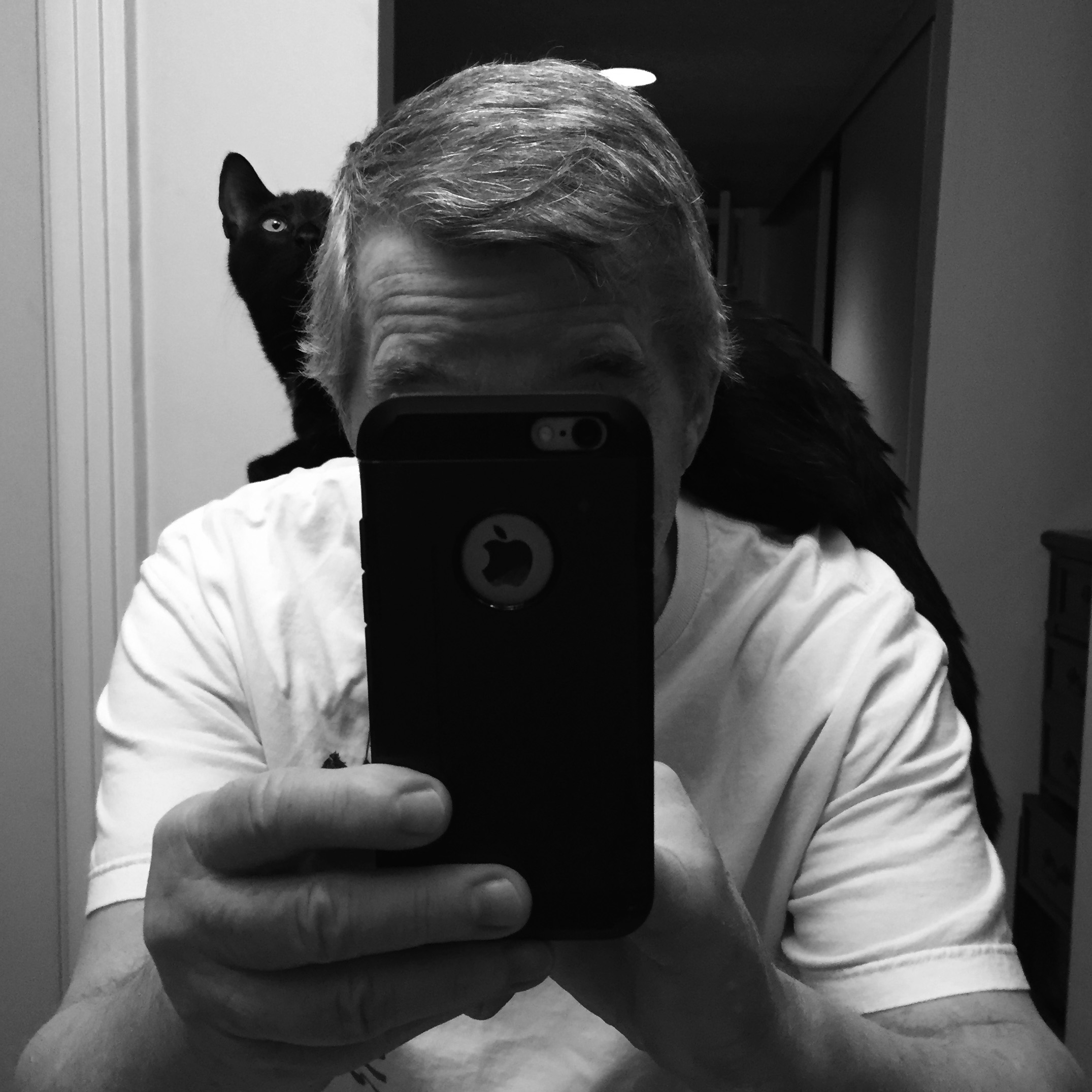
Evan Laughlin grew up in Phoenix, dreaming of becoming a writer of fiction. Accordingly, he went to law school and spent a couple of decades writing legal briefs. Not being terribly bright, it took him that long to realize that memoranda of points and authorities, though often fictive in nature, were not the type of writing he had imagined for himself. Evan quit the law; both he and the law are better for it. His favorite historical disagreement is described in the reported decision Those Who Advocate the Elimination of the Semicolon v. Every Rational and Virtuous Person in the World (citation omitted).