Her dark curls bouncing, the stout woman leaps over a rock and positions herself beside me. CLIC, CLIC, CLIC sings her Canon’s shutter. I measure the correct amount of light for the landscape and adjust the old Yashika’s F-stop accordingly. Push the button, and now we both have the shot. Hers develops into the better photograph, though I saw it first.
Take one for the team in our first day in the competition of the annual International Doğa Photography Festival in Turkey. The leaper, Eleni, is on the Greek team. I’m on the Nederland team, thanks to my photographer husband’s Dutch citizenship and a few magazine credits. At the last minute, he had a retina come loose. While the surgery went well, it left the team with a sudden vacancy, and I filled in. Now I’m the only person from the USA in the competition——and in this 90,000-person town. Unfortunately, my credits are for illustrations, not photographs, and I’m afraid that will soon be evident. But it’s an adventure, an unexpected opportunity for a guided trip to Turkey.
We’re all housed in the 13th century monastery at the edge of Vizirköprü, a long bus ride from Samsun’s airport on the Black Sea. The team from Iraq sleeps down the hall; teams from Bulgaria, Syria, Turkey, and Greece reside in other sections of the two-story quadrant. My room is eerie, once a monk’s cell, with thick stone walls, a niche for a large, plain cross, and a wooden door decorated in iron studs that opens onto the balcony that wraps the inner courtyard. The narrow bed is the only furniture, hooks on the walls serve as the closet. The camera fits in the niche, in front of the cross, at the ready. I like it.
I like the rules, too. The competition is relaxed, sponsored by the tourism division of the Turkish government. Their goal is to come out with winning photos of the area for promotion; pretty pictures in social media, spread through the competing countries. Every year the location changes, and this year we are inland, in the Samsun region. Local drivers will chauffer us around in vans for four days. On the fifth day, a Friday, judges will finish evaluating our submitted shots. That evening, the mayor and other officials will present awards at the opening of the International Doğa Photography Exhibit in the town square.
In the coming week, what moving and iconic visions will we compose and capture? Which team, which photographer, will have the best Eye?
Eye for composition. Compose the shot within the camera, so there is no need to crop later. Position your lens for the angle. Frame the subject precisely, whether a building and mountain, reflection in a wine glass, or only a foot on sand. What you want seen is seen, in focus—or not. Intention transmits your vision.
Eye for aesthetics. Clouds, castle, castanets, cornflower. Take a photograph that evokes the same awe and emotion as the Eye feels. Photo enhancement can do this easily, but a perfect shot “in camera” must draw on a wealth of knowledge.
Eye for meaning. Artists see symbols in form. They juxtapose multiple images that trigger emotion and thought. Photographs use shape, color, contrast: a fish head and a smile, a man hunting on a garbage dump. Waken the viewer’s Eye.
Eye for moment. See it, shoot it. News and sports photographers “get the shot.” It’s timing that matters and these photos can stop or start a war, possessing power for change.
A photography contest evaluates your vision, conveyed through composition and capture.
I have the Eye but not the skills necessary to capture my visions. A half-remembered college photography course and a quick digital tutorial on YouTube still leaves me floundering. I don’t belong here. But I do have the Eye and it soon becomes obvious that Eleni has noticed it.

Day One, and our van is headed for more photogenic sites. We park for an overlook view, when three young boys appear around the dusty curve behind us, playing with their walking sticks. I leave the group and slowly approach, not wanting their behavior to change. Two shots and Eleni is there. CLIC, CLIC, CLIC. An Iranian in his long robe is attracted by the sound, followed by the Bulgarian woman in her embroidered blouse and jeans. The boys start posing shyly for all the teams’ closeups. I sneak a picture of the scene from afar. It’s not good——I can’t capture the facial expressions of the photographers, their intent concentration. What I have instead is a melee of forms on a dusty road.
Lunch with the van driver’s family in the countryside. They spread the feast upon an embroidered cloth on the common room’s floor. We relax on pillows, eating together. When I shoot closeups of the plate of golden lentils adorned with oil juxtaposed with a pillow’s golden embroidery on vivid magenta silk, Eleni moves to my elbow. CLIK, CLIK, CLIK. We have the shot.
Halfway through the day and it’s happening repeatedly. Why am I her point man? Eleni is not on our team and never asks my permission——not from lack of language. Even a smile or nod could acknowledge that I have found that compositional gem she desires. I’m learning that in a competition it is the shot that matters, not the niceties of getting it.
If our team wins, there will be a blurb and a winning photo in a few photography magazines. It means nothing to me but a warm glow and a Facebook post. The photos won’t even go in my illustrator’s portfolio. To some of these competitive photographers, though, it could mean a national recognition, a place of pride, a supplemental award from their country’s cultural organization, perhaps a photography scholarship or teaching position. There are actual medals at stake; they are hanging in a display case at the monastery with the past winners’ winning compositions. A picture pops into my head:
Eleni accepting a medal for her closeup of a young boy.
At our next stop, I poise on the cliff’s edge, viewing beautiful Altınkaya Dam Lake, caves, goats and brush dotting the landscape on the opposite side of the canyon. I search for a focus in the vastness of the wild. BUMP. Eleni! She hip-strikes me aside and stands in my place. There is plenty of room on the clifftop, but now she inhabits my vision:
Eleni, looking through her viewfinder, takes a misstep and pitches over to the lake below.
I chuckle at the thought and seek another shot, Eleni already watching for my next choice.
At the monastery each photographer emails their three best photos to the organizer. Printed overnight, in the morning they hang from a thin rope stretched across the quadrangle’s courtyard. While my Eye found many good compositions that first day, it is Eleni who made the best captures. Her photo of the boys, of the food, of the landscape——they are magazine perfect. She is an accomplished photographer. What Eleni knows she doesn’t have is the Eye.
Years ago, journalism school opened my eyes to my shortcomings: I would not make a commercial deejay because I could not improvise entertaining “chatter.” I would not make an investigative reporter because I lacked assertiveness. I would not make a news videographer because I wouldn’t jostle and elbow and dodge, putting myself and my shot physically before others. Eleni would make an excellent paparazzi——she is very good at positioning herself in a way to steal my shot. But there is something more than that. I feel pressure at the back of my neck and eyes whenever she nears. I am losing my concentration, and like an overlit, underdeveloped photograph, my joy is fading.
Day Two, Eleni squeezes next to me in the van. Watching the scenery unroll, she skips eye contact. When the van stops, she doesn’t bother looking for her own shots. Eleni sits on my heels like a bloodhound. No one seems to notice——their eyes are their own, looking for prize-winning photographs. So far there is not much socializing between the teams, so if one of the competition goals was international fraternization, it is not working. Everyone is ignoring everyone. Lucky me.
Women sow a field, following a plough pulled by a tractor driven by a man. Others walk behind him to steady the harrow. I get the feeling the people will pull the tractor itself if needed. There’s plenty of food for thought in this crop, and I want to express it with my compositions. But unnervingly, her CLIC, CLIC, CLIC sounds every time I raise my camera. It’s no longer a song. It’s an alarm.
On our way again and soon the van halts for a goatherd and his flock to finish crossing the road. We spill out and after some closeups of a particularly wild-eyed goat, I have an idea. Fresh offal is densely scattered on their trail, and I compose the herd in the background with a pile of it sharp in the foreground. Does it mean anything? It’s just a unique vision, it surprised me, and I want the shot. With a low angle and rack focus, the goats are delineated with a pile of round fuzzy shapes in the foreground. I feel Eleni watching me, but despite the sound of my camera shutter, hers doesn’t move. She doesn’t like this subject.
At lunch Eleni sits across from me, one eye on me, one on the food. She is not only stealing my angles; she is stealing my peace.
Evening, and I sneak away through the monastery’s open gate to walk the lanes of Vizirköprü. Of course, I take my camera. In one yard a woman and her daughter are at the oven, baking bread. Waving me into the yard, they show me how it works: the coals and the warmth they create in the clay, which could I think, have been there for generations. Then they draw out a loaf on a wooden paddle to share with goat cheese. I revel in the freedom of taking pictures when I want, where I want, though my photos still miss the point, especially in this light. They never look like what I see—not in reality, not in my mind’s eye. Unworthy of the contest, at least these compositions and captures are mine, in creation and in deed, in compose and in capture.
Our Third Day we are on our way to a women’s cooperative, where the weavers watch us as closely as we watch them. They have never left the village; a middleman takes the wares to Istanbul for the bazaar. Looms, yarns, textiles and the women’s bright faces provide a photographer’s paradise. I forget the competition and talk with the women in gesture and translation. I am so delighted with the prices and their workmanship, the innocent pride as they see my admiration, that there is no haggling as there would be in the bazaar or shops of Istanbul. A hallway rug and a pillow cover will go home with me. As I click my photos of the rug’s maker, someone steps on my sandaled toes, hard. I stumble. CLIC, CLIC, CLIC and when the camera comes away from Eleni’s face, I meet her eyes. Triumph mixed with malice. No apology.
Eleni, rolling, smothering in a Turkish rug.
Outside, a creek dashes down the mountain, into a crevasse and under the road. The town lies across a bridge. From there I see brilliantly colored rugs drying in the sun, hung above the water after their wash in the stream. I think of stories of Monday Washday and Spring Cleaning.
As I raise my camera and point to the colorful melee, CLIC, CLIC, CLIC resounds in my left ear, causing my hand to tremble, spoiling my shot, spoiling my mood.
Poor Eleni, on the bridge and fiddling with her settings, loses her balance and plunges into the dangerous rapids below.
Our next stop is a logger’s home in the forested hills. The farmhouse shares a wall with the stable. Piles of cow manure are stacked along that wall, keeping the home warm as it decomposes. The women set out our picnic and a towering Turkish teapot, the çaydanlık, upon tables of hand-sawn logs still retaining their bark. The others are roaming, and I take my time from my seat at the table, framing this iconic sight, the stone wall and stable in the background. Captured. Then Eleni sits beside me, moves closer on the bench, thrusts her camera in front of me and leans into it. I shamefully squeak and slide away. Does she racks focus on one of the shots, as I do, to bring the çaydanlık into sharpness and blur the background? She rights herself and takes a piece from the plate of Turkish candy.
Eleni, poisoned by the picnic’s sweets——her sacrificial death alerts us all.
We have a view from this mountain top, and there is more height: a swaying rope-and-stick ladder leads up a watchtower on the edge of a cliff, for a stunning, surreal view of surrounding mountains and valleys. Only two can climb at a time and I escape my shadow. From the watchtower, I see Eleni enter the nearby forest alone. Hurry! Back down the shaking ladder to follow her. Stuffing my yellow neckerchief in my pocket, I move quickly and quietly through the woodland, adjust the camera’s lens for the shade, set a silenced snap. There! I have the soundless shot. Slip back, stroll to the picnic table, and ask for “Tea, please.”
Day Four, and I go down early, first to see the teams’ printed photos of the weavers, the cows, views from the watchtower. As I expected, Eleni has taken the same angle from the bridge as I——her contrast is sharper, her colors more saturated. We have similar shots of the same young woman’s intent face, framed through the sparse yarns stretched across her loom. This time, it is Eleni’s focusing ability that makes her picture special, mine ordinary. Our third shots are different. Hers is of patterns of the stripped-tree hayrack juxtaposed with the tower’s log ladder in the background. It’s familiar——I had positioned myself to take it, Eleni following.
My third shot is an abstract of rounded shapes in varying mono-shades of brown, barest beige to near-black, some parts sharper, others softer, taken with a long lens from a distance. I hope Eleni will recognize that I violated her privacy——some of those shapes are her hips, and some of them are what came out between them. All in closeup, all in one 8 x 10 print for all to see, an abstract print that no one will choose as a winner.
While I eat scrambled eggs, Turkish bread, yogurt and dates in the shade of the colonnade, I keep an eye out for my nemesis. Eleni enters the courtyard and beelines to the hanging photographs. She looks first at hers, then steps to mine. At the third shot, she stiffens. She looks my way and I can feel her glare’s heat. Eleni has the Eye, after all.
As we climb into the van to visit a recently discovered Hittite archeological site, Eleni takes the last seat. She will be first out of the van, and Day Four, the woman will seek her own vision.
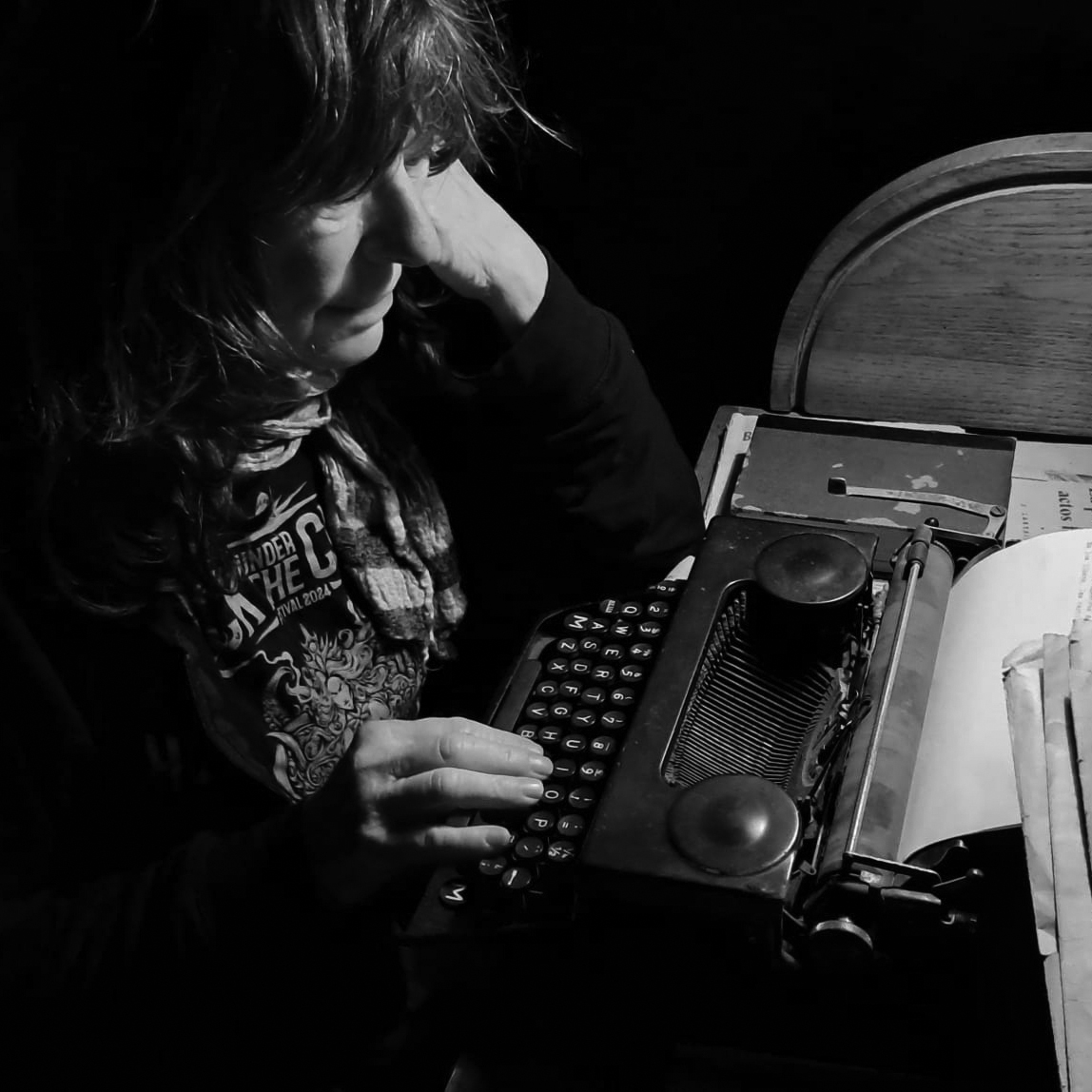
Deborah Douglas Wilbrink is a retired memoir ghostwriter who shifted into fiction last year. She has been a journalist, video news editor, commercial producer, and cemetery manager. Her stories are finding publication (Asymptote, Persimmon Tree, Southern Mule, Bright Flash, and more) and she’s seeking an agent for “Free Tits and Other Stories from the Second Wave” that was completed at a residency awarded by Can Serrat in Spain. She’s also a singer-songwriter; her murder ballad “Debrina’s On Fire” is on YouTube. More stories and music are at GuitarsAndMemoirs.com. Her favorite revenge song is “Goodbye Earl” by The Dixie Chicks.