Q: What about the anger that rises so easily inside you?
A: I’m going to therapy again. But it takes time to establish a relationship. To build a trust. To talk about the parts of me I don’t want to talk about. The angry parts. So I’m writing it down. Not all of it. Some of it. A part of it. How trustworthy is the narrator? I’ve been angry a really long time. As if I was born with a deep-rooted anger. Or maybe a revenge? Perhaps a collective trauma? When we talk about queer people, we so often hear stories of resilience, strength, survival. Narratives we’ve told ourselves over and over. In part, it is what keeps us going in the face of so much hatred. But I want the stories of queer anger. Our collective anger. Of how angry this world makes us and the amazing fact that we so often put that anger into such wildly entertaining and joyous forms. But the anger is there. Do not be mistaken. I began with myself and quickly turned to the collective. Did you notice? An attempt to contextualize my own anger. But I don’t know that I fully understand my anger. How trustworthy is the narrator? Those of us raised as boys are so often told to hide our emotions. That boys are not emotional which couldn’t be further from the truth. Emotions have no gender. But boys are taught to hide. Taught not to show. Taught not to cry. Taught not to feel. Not to love outwardly. To love too much might make you appear what? Gay? Queer? A fag? Emotions are gay. What are you a girl? How trustworthy is the narrator? But what if you are an emotional boy? I was an emotional boy. Emotional in a world that was constantly telling me not to be. To not react the way I did. But anger is a “boy emotion.” As in allowed in doses. As in “manly.” A place to channel every feeling. Every desire. Every broken thought. Every fucked-up contradiction inside you. So anger bubbled up at a young age. Bursts of emotion. Turned to anger. Sometimes violence. A pattern that would follow me my whole life. How trustworthy is the narrator? I find myself here in my 40s confronting this anger for the first time. Or what feels like a first time. A true confrontation. There have been other attempts. Failed attempts. Which makes therapy hard. As in I’ve tried before. But failed. But this moment feels different. I’m coming to a messy understanding. A giving of grace to myself for mistakes. My anger is often warranted. But my actions sometimes misplaced. Maybe this is why I write so much. Why I’m constantly trying to figure myself out through words on a page. Or through others’ words on a page. A screen. A song. Something must make sense. Someone must know the answer. How trustworthy is the narrator? I’d be lying if I said I wanted my anger to completely disappear. Anger is a necessary emotion. A driving force. We should all be angry. And anger has no gender. No sexuality. But to be queer is to be angry. At all the ways this world fails us. Hates us. Makes our presence into resistance. Into rebellion. To be seen. To be queer and seen is a power unto itself. So I’m learning to channel that anger. To create more. To speak louder. To be an emotional messy fag. To forgive myself. But how trustworthy is the narrator?

Q: Where does the violence go once you sit down your phone?
A: Does it fade away like a book I read years ago? A classic I pretend to remember better than I do. A student in my class creates an erasure poem using a page from Jane Austen’s Persuasion. I ask her when she read the book. School or on her own? I’m just curious. Not accusatory. But she hasn’t. Says she just searched the internet for a page. A random page. Found it on Pinterest. To do the assignment. My assignment. An erasure poem. She doesn’t lie like I might have at that age. Wanting to seem smarter than I was. More well-read. My students don’t care to say they don’t know. Or haven’t read. Or haven’t done. I don’t know if this is a good thing or a bad thing. But good and bad are often irrelevant. There is a genocide happening. More than one. Which seems to be the constant state of the world. If you are paying attention. Or have the right algorithm. My social media feed is full of pop culture references, nearly naked queers, and dead bodies. Blown to bits. All mixed together. Our new normal. I try to put my phone down. Rest. But it holds a strange power. Like an extra limb. A piece of me. The first thing I touch in the morning. The last at night. Even though I constantly long for the days of no phone. I do remember them. I am old enough to remember them very clearly. That different kind of connection. Just being. In a space. Alone. Or with someone else. Together. I do remember. But then there’s the guilt of not knowing. Of the putting down. Of not witnessing all of the images of all of the horrible events of the world. A deep-rooted guilt of being lucky at least in this moment. As luck can change. People forget that. But then I do eventually put it down. For stretches. To make dinner. To make cocktails. To watch a TV show that might also be about how horrible the world is. Rich actors making fun of rich horrible people while getting richer. But my hand creeps back to the phone. To the scroll. To the images. To the stark contrast of my life against others. Against the backdrop of so much violence. So much hatred. So much dehumanization. And my head feels like it’s almost separating. Creating a new space to hold these images. Hold that pain. A gap is created. A space between. Where violence is there but not. Real but not. In my hand but not. Sometimes I trade my phone for a book of poems. Which I read aloud. Today a rereading of Diana Khoi Nguyen’s beautifully haunting book Ghost Of. Which deals with loss and grief and images there and not there. She writes Why should we mourn? / Isn’t this the history we want / one in which we survive? I snap a picture of this page with my phone. Now her words live inside my phone inside my hand as I move through my day with the book back on the shelf. Is it all a question of survival? Of who gets to survive? Of who gets to tell the story? Or a story? And what story am I telling? And does it matter? I often think it doesn’t. That my particular story doesn’t matter even if I do believe all stories matter and I don’t mean that in an “all lives matter” way, but as in I tell my students they matter. All of them matter. Their voices matter. And sometimes they hear me. Really hear me. I break through the noise and they write something so true. So real. So heartbreaking that I forget all about my phone for a minute or two or three. It sits untouched. A black box of the world’s horrors that will be waiting for me. Whenever I’m ready. Or even when I’m not. Because eventually my hand with reach out and begin again with or without my consent.
Q: What of masculinity?
A: There’s a lot of talk of crisis. Masculinity in crisis. A crisis of masculinity. We love the word crisis. Don’t we? I was born male. I have a penis. I am attracted to men. These are facts that might mean I have something to say about masculinity. And yet I’ve written over and over again that I don’t quite feel male. Not male in the way others want you to be. Need you to be. Perhaps my own masculinity is in crisis. Or is it chaos? And is that one in the same? I prefer chaos to crisis. I think. But the fact is I don’t really care that much about gender. Not nearly as much as others do. That obsession. I have lived my life othered. Outside. That is the life of a queer. Which is often mistaken by non-queers—non-outsiders—as a bad thing. Sad to be outside. Don’t you want to be inside? Yet, I don’t. Queerness saved my life. The crisis of masculinity is mostly a hetero crisis. And in the words of John Waters’ Aunt Ida, The world of the heterosexual is a sick and boring life. I have no interest. I look in from time to time. Ask are straight people okay? Shake my head. And move onward. But the crisis of masculinity will find you. That’s the problem with a crisis. Like the boys in my class. I call them boys yet they are sort of men. Almost men. 18. 19. A few only 17. In college. First year. Many are more in-tune with their emotions than the boys of my college days. They write of hurt. Of failed fathers. Of body issues. Lots of body issues. Some obsessed with the gym. Gaining muscles and abs. With making money. Things they’ve been taught bring them value. Men long to be valued. But under the surface is the deeper crisis. Bobbing there. Forcing me to see. To respond. One boy talks of ideas he’s learned from Andrew Tate. Tate’s name isn’t mentioned at first. But then appears. Exposes itself. Now that is a man in crisis and chaos. The world of the heterosexual is a sick and boring life. This boy is kind in class. Engaged. Yet underneath there’s conflict. He wants to define himself as masculine. Believes this brings him power. Women. Money. Things he deserves. Deserve is a hard word to live your life by. But I must engage him on his ideas. Bring curiosity. Questions. I don’t want to push him away. Plus we only have three months together. A semester. I leave him feedback on his essay about Andrew Tate. Bring up my concerns. He’s cherry-picked quotes. Doesn’t answer for accusations. Doesn’t acknowledge other viewpoints. I don’t know that I’ve gotten through. But he keeps coming to class. Keeps engaging with me: his very queer professor. He passes the class. The next semester I see him on campus. He waves. Smiles. Says how much he enjoyed the class. My crisis is one of teaching in a world that doesn’t always want to learn. To engage. A world that’s so full of contradiction. A world in chaos. Everything gray. Many years ago, I met a guy on Grindr. Planned a hookup. He loved my pics. Wanted me to fuck him. I showed up at his apartment building. He came down to meet me. We talked for just a second. Then a flip switched. He was no longer interested. Was direct, which I appreciated. Offered me to come up for just a drink, if I wanted. I declined. This had not happened before. It stung for a moment. Stung because I knew the issue. It was an issue of masculinity. There I was inside the crisis. A gay man wanted me to fuck him. Liked my dick. My face. My pics. All current. And then? Things you can’t see in pics. How I hold my body. How I move through space. The sound of my voice. Sometimes the world of the homosexual is also a sick and boring life.
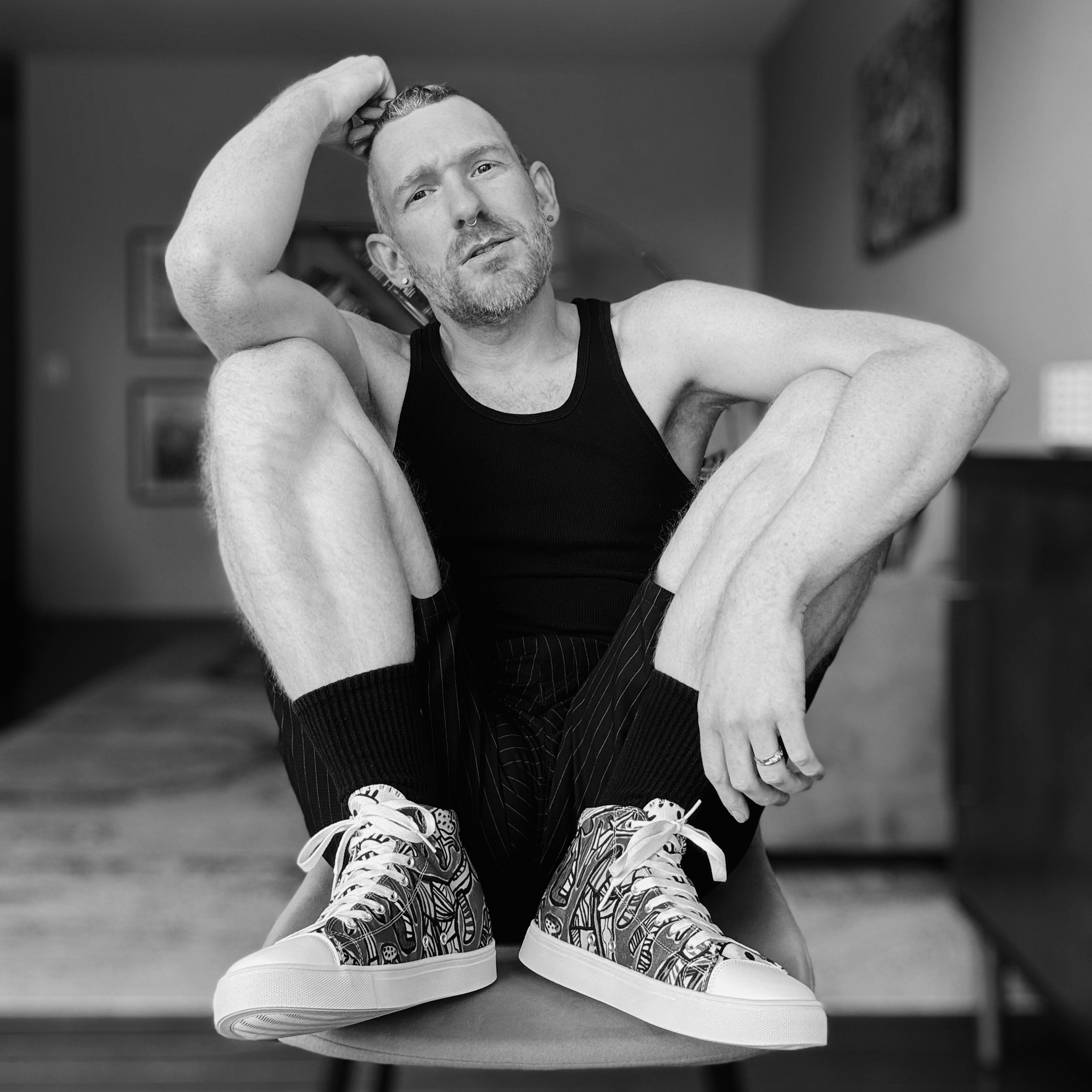
Stephen S. Mills (he/they) is the author of the Lambda Award-winning book He Do the Gay Man in Different Voices (2012), A History of the Unmarried (2014), Not Everything Thrown Starts a Revolution (2018), and Final Slash Boy (2026). His work has appeared in The American Poetry Review, Fourteen Poems, The Los Angeles Review, and others. Two of his books were placed on the Over the Rainbow List compiled yearly by the American Library Association. He is a 2026 recipient of the BRIO Award from Bronx Council on the Arts. His fifth book Magical Queer Thinking: A Flash Memoir in Questions will be out in November of 2027 from Broken Sleep Books. His favorite revenge story is Sweeney Todd: The Demon Barber of Fleet Street because a story about the working class rising up and taking revenge on the wealthy and powerful never goes out of style. Website: http://www.stephensmills.com/